About — Arian Chandra




Biography
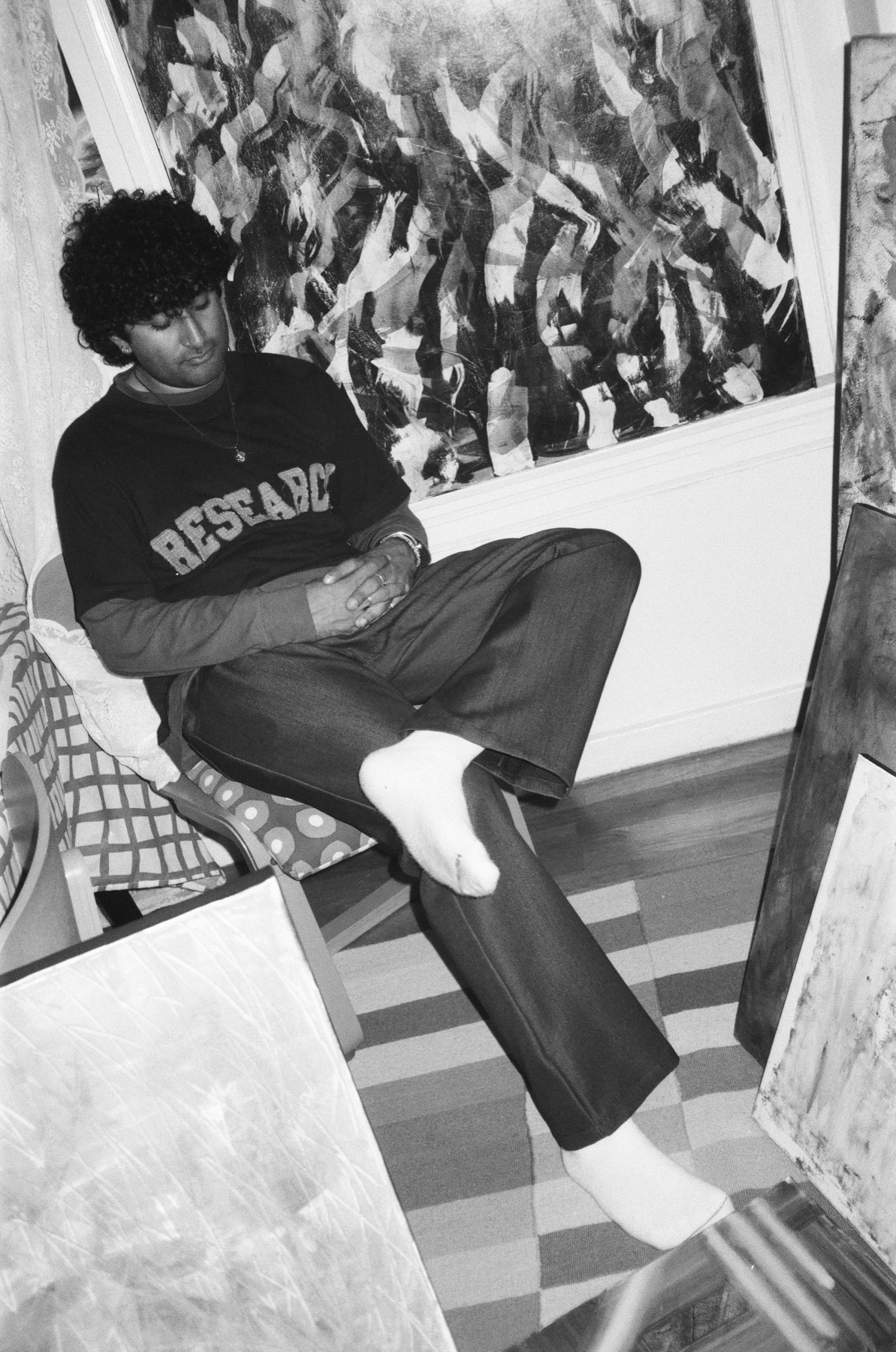
Arian Chandra (b. 2001, Palo Alto, California) is an abstract painter based in San Francisco. He works primarily in oil and acrylic on canvas and has also made double-sided acrylic paintings on plexiglass. His layered, asymmetrical compositions develop through scraping, wiping and rebuilding the surface, with the palette knife as his primary tool.
Chandra began painting in 2023 while studying design at Lehigh University. He earned a Bachelor of Arts in Design in 2024, with minors in Japanese Language and Apparel Design.
His solo exhibition Garden of Arjun was presented at Mountaintop Gallery, Lehigh University, in Bethlehem, Pennsylvania, from April 4 through August 31, 2024. Supported by a College of Arts and Sciences Undergraduate Research Grant, it brought together four double-sided acrylic paintings on plexiglass, each measuring 30 by 36 inches, in a freestanding installation.
CV
Solo Exhibitions
2024
Garden of Arjun, Mountaintop Gallery, Lehigh University
Awards
Graphis New Talent Award 2024: Honorable Mention
College of Arts & Sciences Undergraduate Research Grant
Education
2024
B.A. Design | Minors in Japanese & Apparel Design | Lehigh University
Exhibitions, studio visits and professional inquiries: arian@arianchandra.com
Artist Statement
In much of my life, I want things ordered and precise. Painting gives me room to work without knowing exactly where I am going. I can make a decision, see what it changes, and let that change redirect me. An awkward stage can become part of a composition I could not have planned.
I make intense, maximalist abstractions, primarily in oil and acrylic on canvas. Even when a painting is soft, there is a lot happening in its layers. I like forms to connect across an asymmetrical composition, giving the eye several paths through the work. I begin by choosing colors, judging quickly whether they feel right together. As the layers accumulate, I stop and look. The image remains open while I decide what belongs in it.
Music is the clearest parallel to how I paint. When I write a song, I begin with a chord progression and find a melody by playing over it before I know the whole piece. An initial arrangement of colors gives me something to respond to in much the same way. Each addition changes what might come next, and I have to recognize which direction is worth following.
The palette knife feels like an extension of my hand. Scraping with it brings me closer to the paint than a brush does. I cover layers, wipe sections away and build over what remains. I like oil's long drying time because I can keep blending and reworking it. I want someone looking at a painting to be able to see how it was made, including the places where I changed my mind.
I am drawn to work that makes another person's concentration visible. Seeing the effort someone has put into a surface can hold my attention as much as the image itself. That matters in my own work too. Some paintings fail, and returning to them helps me understand which decisions weakened a composition. Working intuitively takes that kind of attention, even when a choice happens quickly.
The shapes and colors in a finished painting can carry a great deal of feeling. I sometimes need time with it to understand my own response. I am interested in how colors and shapes can lead someone to search for meaning without offering a recognizable subject. A title can suggest a direction, but what a person finds will depend on what they bring to the painting. I don't expect someone else to feel what I feel.
Art can offer solace. Music and painting have done so for me, and the possibility that something I make could matter to another person is part of why I keep working. I like the thought of a painting becoming something someone lives with and returns to, finding different things in it over time.
Portfolio
Selected paintings and exhibition documentation.


Biography
Arian Chandra (b. 2001, Palo Alto, California) is an abstract painter based in San Francisco. He works primarily in oil and acrylic on canvas and has also made double-sided acrylic paintings on plexiglass. His layered, asymmetrical compositions develop through scraping, wiping and rebuilding the surface, with the palette knife as his primary tool.
Chandra began painting in 2023 while studying design at Lehigh University. He earned a Bachelor of Arts in Design in 2024, with minors in Japanese Language and Apparel Design.
His solo exhibition Garden of Arjun was presented at Mountaintop Gallery, Lehigh University, in Bethlehem, Pennsylvania, from April 4 through August 31, 2024. Supported by a College of Arts and Sciences Undergraduate Research Grant, it brought together four double-sided acrylic paintings on plexiglass, each measuring 30 by 36 inches, in a freestanding installation.
CV
Solo Exhibitions
2024
Garden of Arjun, Mountaintop Gallery, Lehigh University
Awards
Graphis New Talent Award 2024: Honorable Mention
College of Arts & Sciences Undergraduate Research Grant
Education
2024
B.A. Design | Minors in Japanese & Apparel Design | Lehigh University
Exhibitions, studio visits and professional inquiries: arian@arianchandra.com
Artist Statement
In much of my life, I want things ordered and precise. Painting gives me room to work without knowing exactly where I am going. I can make a decision, see what it changes, and let that change redirect me. An awkward stage can become part of a composition I could not have planned.
I make intense, maximalist abstractions, primarily in oil and acrylic on canvas. Even when a painting is soft, there is a lot happening in its layers. I like forms to connect across an asymmetrical composition, giving the eye several paths through the work. I begin by choosing colors, judging quickly whether they feel right together. As the layers accumulate, I stop and look. The image remains open while I decide what belongs in it.
Music is the clearest parallel to how I paint. When I write a song, I begin with a chord progression and find a melody by playing over it before I know the whole piece. An initial arrangement of colors gives me something to respond to in much the same way. Each addition changes what might come next, and I have to recognize which direction is worth following.
The palette knife feels like an extension of my hand. Scraping with it brings me closer to the paint than a brush does. I cover layers, wipe sections away and build over what remains. I like oil's long drying time because I can keep blending and reworking it. I want someone looking at a painting to be able to see how it was made, including the places where I changed my mind.
I am drawn to work that makes another person's concentration visible. Seeing the effort someone has put into a surface can hold my attention as much as the image itself. That matters in my own work too. Some paintings fail, and returning to them helps me understand which decisions weakened a composition. Working intuitively takes that kind of attention, even when a choice happens quickly.
The shapes and colors in a finished painting can carry a great deal of feeling. I sometimes need time with it to understand my own response. I am interested in how colors and shapes can lead someone to search for meaning without offering a recognizable subject. A title can suggest a direction, but what a person finds will depend on what they bring to the painting. I don't expect someone else to feel what I feel.
Art can offer solace. Music and painting have done so for me, and the possibility that something I make could matter to another person is part of why I keep working. I like the thought of a painting becoming something someone lives with and returns to, finding different things in it over time.
Portfolio
Selected paintings and exhibition documentation.